Hurumlandet is very rich in terms of biodiversity, the project area for the explosives factory is no exception.
Chemring Nobel was commissioned by the state to look at various alternatives for locations for the explosives factory; 10 locations were researcheand assessed, with regard to environmental qualities. The investigations were carried out by Norconsult, which assessed the environmental status of each location (link to assessment here). Norconsult is one of Norway’s largest consulting firms and thus an important part of the defense industry’s pursuit of increased profits. This cannot be considered an independent process and looks more like a pseudo-democractic process. All of the proposed locations had environmental qualities of significant regional and national interest.
The assessments of a consulting firm,driven by profit and self-interest, were heard; the government decided to proceed with Hurumlandet. The reasons given were «favorable topographical conditions, proximity to current facilities and access to relevant expertise and infrastructure».
Chemring Nobel itself claims that ecological values should be safeguarded through thorough impact assessments and dialogue with affected parties. However, the scope of such a production facility is covered by regulations on impact assessments. Thus, it is not a measure they are implementing to safeguard nature, but something Chemring Nobel is obliged to do by law.
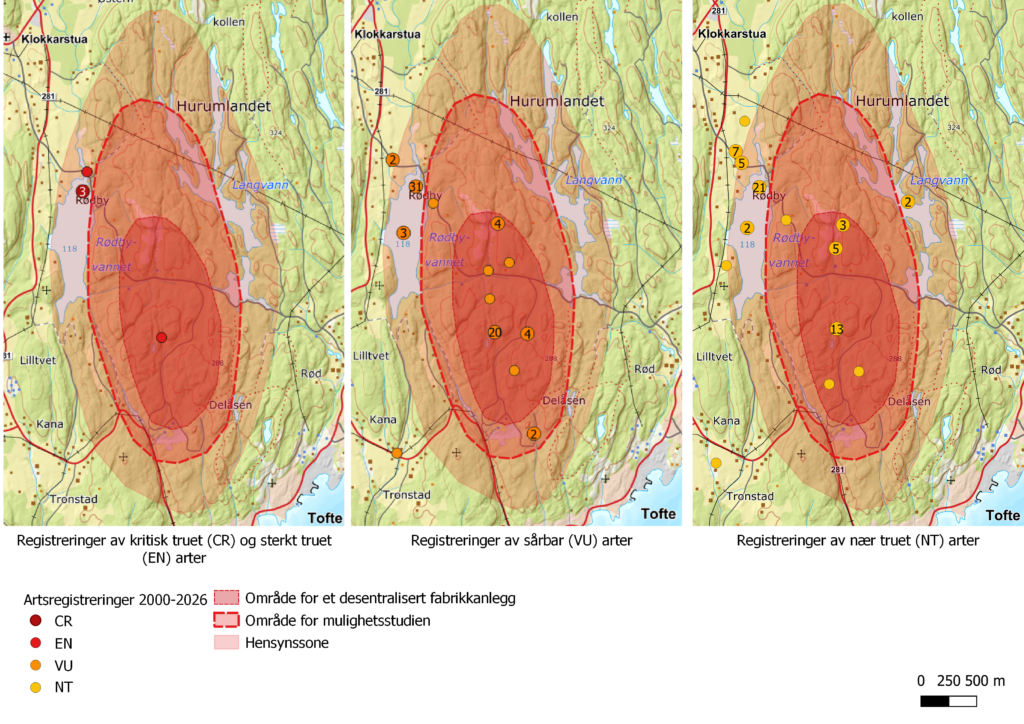
We have examined the available existing knowledge on the biodiversity within the planning area of the factory, as well as the surrounding consideration zone, and the list is long. In its entirety, the area has a great many species registrations, about 1000 taxa registered. Including 53 red list species, with a distribution of 2 critically endangered, 7 highly endangered, 19 vulnerable and 25 near threatened (Figure 1). The endangered species are various types of birds, mammals, butterflies, vascular plants, mosses and fungi. Because highly endangered and critically endangered species live in the planning and affected area, it should be assessed as having «very high value», according to Miljødirektoratet’s (the norwegian environment agency) KU guide M-1941.
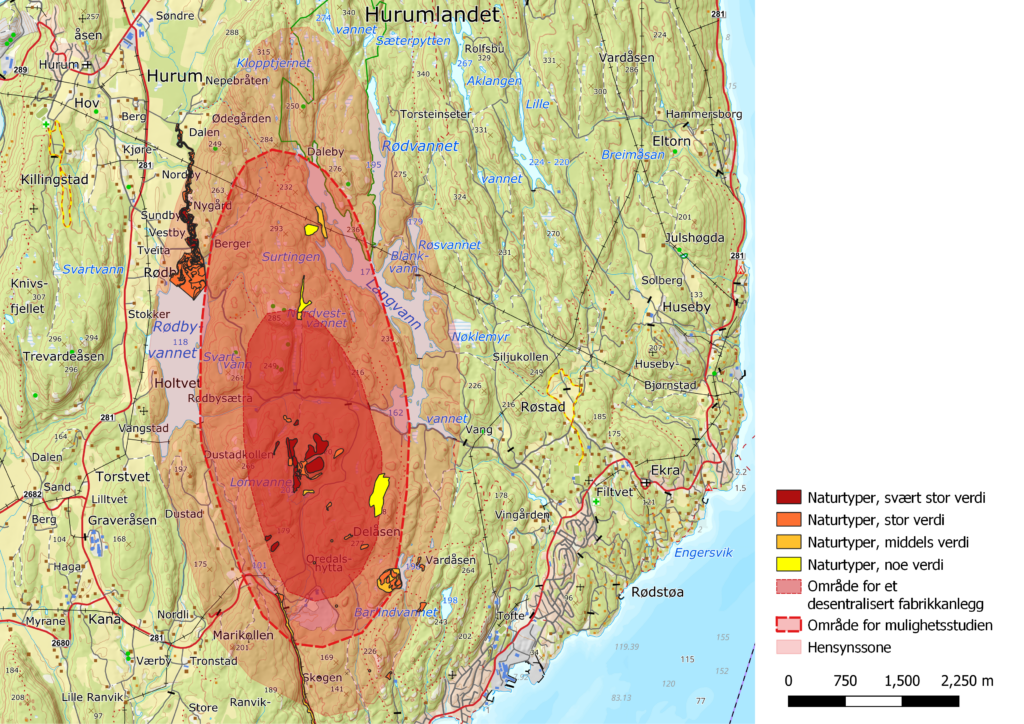
Several habitat types, mainly within forest land, of very high and high quality, have also been registered in the area. Habitat mapping should play a central role in safeguarding species diversity, the range of variation and ecological connections in Norwegian nature. The habitat types in the project area and the consideration zone have been assigned a value based on quality (intactness) and red-list status, according to Miljødirektoratet’s (the norwegian environment agency) KU guide. 16 locations have received the highest value score – «very high value», and 62 locations have received the second highest score – «high value». Several of these are located in the area of the factory plant itself (Figure 2).
In the northern part of the area, within the consideration zone and the feasibility study area, is also the Tofte Nature Reserve. The area is protected to preserve an intact forest ecosystem of a large number of thickly grown old spruce forests with a rich flora. There are several special habitat types and red-listed species in this protected area.
Norconsult assessed the area as a whole as «high value» for biodiversity in its assessments of environmental quality. They themselves mention that there are several areas of high and very high value scattered throughout the landscape, and that many red-listed bird species have been registered. But if one is to follow the Miljødirektoratet’s (the norwegian environment agency) KU guide, as one should in such assessments, then the area should have been assessed at the highest value score – «very high value», due to the habitat types with very high quality and the species with high red list status. The valuation is used to determine the impact of the measure on natural diversity, and the higher the value an area has, the greater the consequence of destruction. The KU guide states that when valuing a larger area, as has been done in Norconsult’s assessments, the area should be assigned the highest registered value. This is therefore a failure in the assessment, which we expect to be corrected in the actual impact assessment for natural diversity that will be carried out in the near future.
How is it to protect nature when there is data and knowledge that is not listened to? If Chemring Nobel and the state really believe that they should safeguard natural values, the answer should be very simple – do not seize the rich natural diversity in Hurumlandet!
At the same time, we stand here in AFS Hurummarka and say: No explosives factory! Not here or anywhere else. Chemring Nobel is closely linked to US imperial wars, the German military which is getting more and more fascist by the day, and the Israeli military which both nations provide weapons to. When we express love for life and diversity here in Norway and Hurumlandet, we cannot accept destruction and death elsewhere in the country or elsewhere in the world. Chemring’s profit and the state of Norway’s political interests are international, therefore our resistance and solidarity must also be international.
Let’s stand together against Chemring Nobel and the Norwegian state which supports that profit trumps ecological diversity and human life!